
Why Your Candidate Gets Rejected
After Submission
You submit a “perfect” resume, then get the email: “Not moving forward.” No details. Just rejection. Here’s why it happens — and how to prevent it.
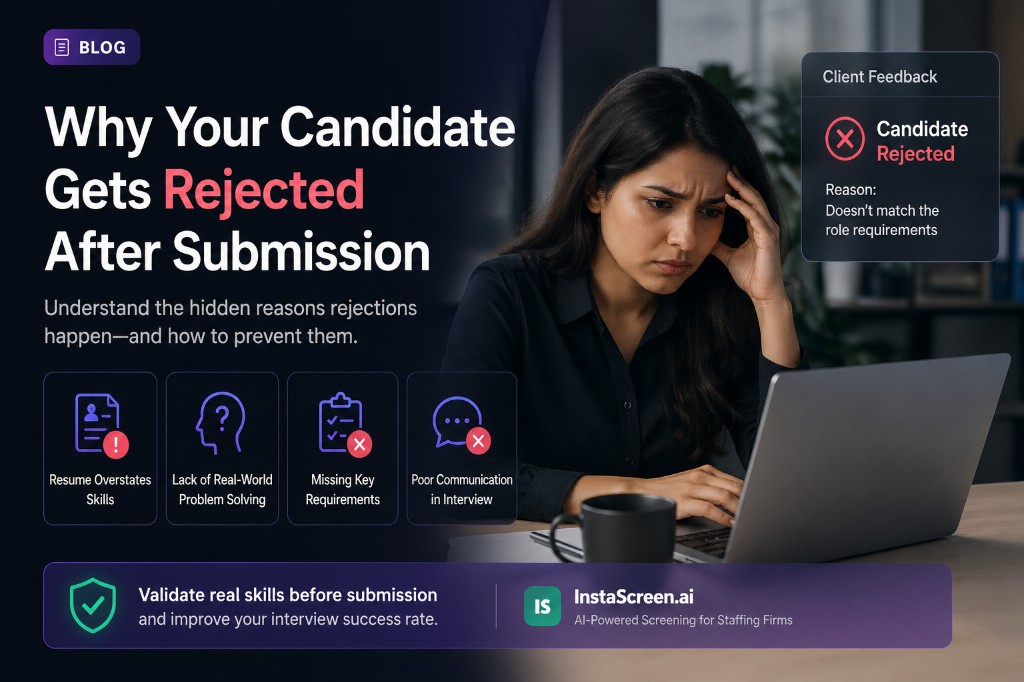
The pain every recruiter knows too well
You spent hours sourcing the candidate. The resume looked perfect—right experience, right skills, right keywords. You submitted the profile to your client with high hopes.
Then the email comes:
“Not moving forward with this candidate.”
No detailed feedback. Just a polite rejection. You’re left wondering—what went wrong? Was it the candidate? The market? Or something you missed?
This scenario plays out daily in staffing and recruitment agencies. A large share of submitted candidates never even get an interview call. The worst part? Many rejections happen after submission, damaging your relationship with the client and wasting everyone’s time.
Why this keeps happening
Most rejections after submission aren’t because the candidate is completely unqualified. They happen because of gaps that surface only when the client reviews the profile or speaks to the candidate.
Common root causes include:
Clients review dozens of profiles each week. They’ve become very good at spotting inflated resumes. When they detect a mismatch early, they reject quickly to protect their time.
Real-world example
A mid-sized IT staffing firm in India was consistently facing 70–75% rejection rates on submissions for React developer roles.
They submitted a candidate with “5 years of React experience.” The resume was polished and matched the JD keywords.
On the client screening call
- Couldn’t explain controlled vs uncontrolled components confidently
- Had never used Redux in a production setup (despite claiming it)
- Struggled with basic hooks and performance optimization questions
“Profile does not match the experience level claimed.”
Not only was that candidate rejected, the client began scrutinizing future submissions from that vendor more closely. Over time, interview rates dropped and the firm lost priority.
The issue wasn’t intelligence — it was that no one validated skills properly before submission.
The solution: validate before you submit
Top-performing recruiters don’t rely on resumes alone. They add a quick, structured validation layer between sourcing and submission.
When you validate upfront, you submit fewer but stronger candidates. Clients notice the difference immediately — higher interview rates and increased trust.
Make validation your competitive edge
InstaScreen is built exactly for this moment. Use ResumeFit to quickly filter, then run a focused screening to validate real skills before submission.