
Why "Just Submit and See" Is Hurting
IT Staffing Firms in a Post-AI Layoff World
When markets flood with resumes and clients tighten the bar, the old habit—move fast, submit first, hope for the best—stops being a growth strategy. It becomes a trust leak.
What changed after the layoff wave
AI transitions and restructuring cycles pushed a lot of strong people into motion at the same time. That sounds like good news for staffing—more candidates, more options.
In practice, clients see higher volume and more similar-looking profiles. Their response is predictable: fewer interviews per submission, faster rejections, and a lower tolerance for "near fits."
When the market was tighter, a decent resume could buy you a conversation. Now, the conversation starts later—and only for candidates who already look credible on skills.
The "just submit and see" workflow (and why it breaks)
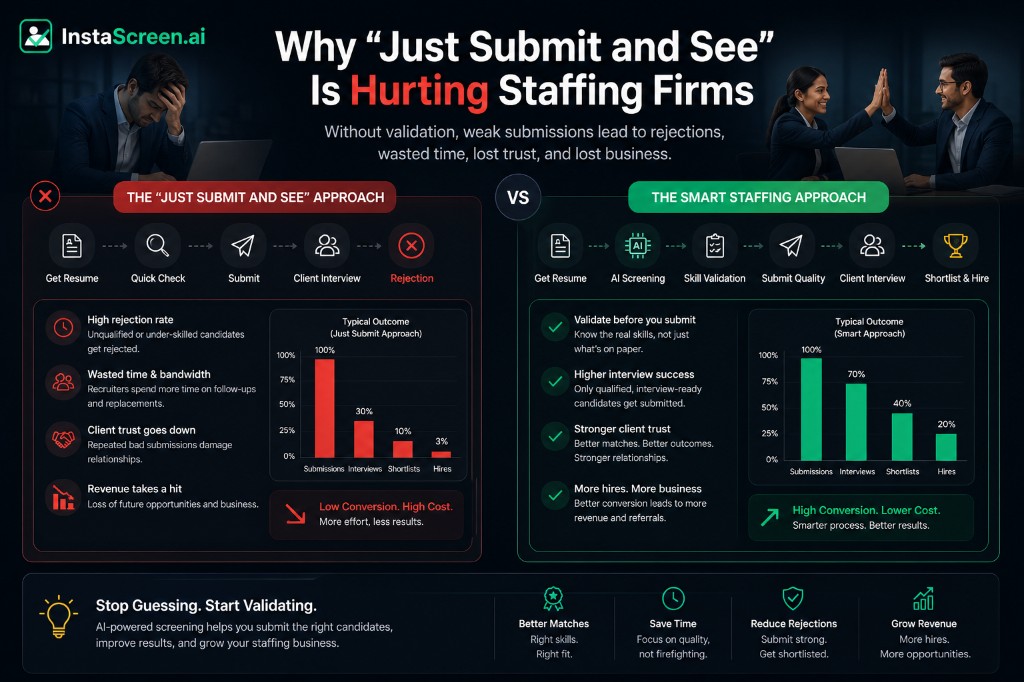
Under pressure, teams optimize for motion: get a resume, do a quick check, submit, wait for the client interview. If it fails, you replace the candidate and try again.
That loop feels productive. It is also expensive—because the cost is paid in rework, recruiter bandwidth, and relationship equityyou can't invoice for.
- Higher rejection rates after client review or first interview
- More follow-ups and replacements for the same requisition
- Clients tightening vendor lists after a streak of weak matches
- Revenue softness that shows up as "fewer reqs," not a line-item
Why staffing firms feel it first
Staffing sits at the intersection of speed and accountability. You're expected to move quickly—but you're also graded on submission quality over time.
In a post-layoff market, clients compare vendors using a blunt heuristic: who sends fewer surprises. A few weak submissions don't read as "bad luck." They read as a pattern.
The firms that win aren't always the fastest submitters. They're the ones whose candidates arrive interview-ready, with skills that match the JD—not just the keyword layer.
What "validate" looks like in practice
Validation doesn't mean slowing hiring to a crawl. It means inserting a structured checkpoint between "looks good on paper" and "client sees them."
Stop guessing. Start validating.
AI-powered screening helps staffing teams raise conversion where it matters: fewer weak submissions, stronger client trust, and more time spent on candidates who are actually aligned to the role.
If your process still ends with "submit and hope," you're competing on luck in a market that rewards proof.