
Resume Looks Strong
but Interview Fails — Why?
Every recruiter has seen this happen. A resume looks perfect, the interview gets scheduled—and then within 10 minutes, the client realizes the candidate can’t explain the work clearly.
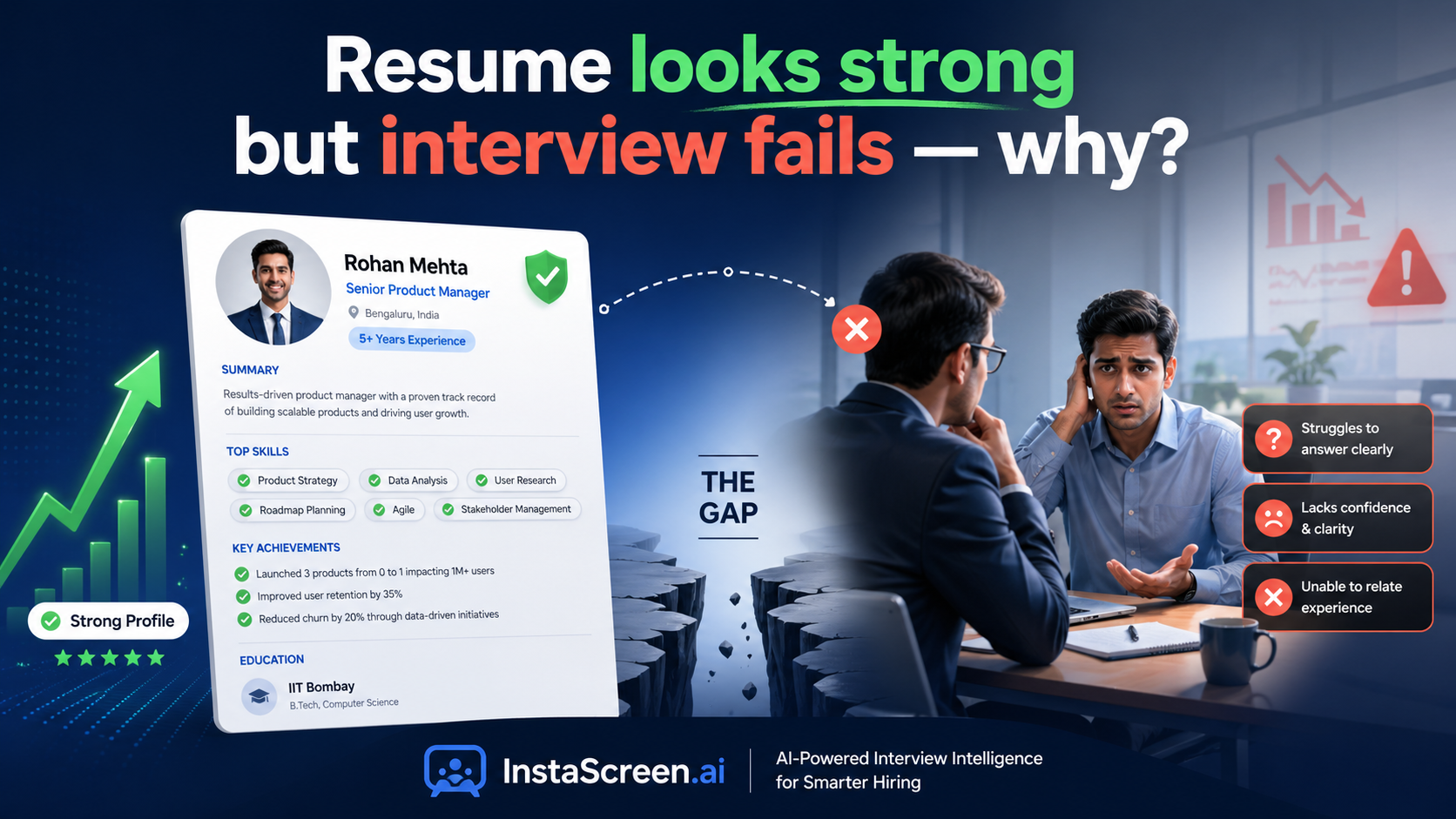
Every recruiter has seen this happen. A candidate’s resume looks excellent. The job titles match. The tools are listed. The years of experience look right. The client interview is scheduled with confidence.
Then the interview happens.
Within 10 minutes, the client realizes the candidate cannot explain the work clearly, cannot answer basic project questions, or cannot connect their resume experience to real execution.
The resume looked strong. But the interview failed.
By the time it happens, the damage is already done. The client’s time is wasted, the recruiter’s credibility takes a hit, and the candidate may never get another chance with that client.
Why this happens
A resume is not always a true reflection of interview readiness.
Many resumes today are heavily polished. Some are rewritten by professional resume writers. Some are optimized by AI. Some are built around keywords from the job description. On paper, the candidate may look like a perfect match.
But a resume does not prove that the candidate can actually explain:
- What they worked on
- Why they used certain tools
- How they solved problems
- What impact they created
- How they handled real project situations
A candidate may list SQL, Python, AWS, Agile, or domain experience, but when asked follow-up questions, they may struggle to explain their actual role. Sometimes they know the buzzwords but not the work behind them.
Real-world example
Let’s say a recruiter is submitting a candidate for a data analyst role.
“Built dashboards using Power BI, wrote complex SQL queries, analyzed healthcare claims data, and improved reporting efficiency.”
In the client interview
- “Can you walk me through one dashboard you built and what business problem it solved?”
- “What kind of SQL queries did you write?”
- “How did your analysis help the business make a decision?”
If the candidate can’t answer with clarity and specifics, the client starts questioning the entire resume—and the recruiter only discovers the problem after the client interview.
The real problem
Most recruiters validate resumes at the keyword level. Clients evaluate candidates at a deeper level.
Clients want to know:
The resume gets them in the door. But communication, clarity, and real skill validation decide whether they move forward.
The better approach
Before sending a candidate to a client, recruiters need a simple way to validate the candidate beyond the resume—without long technical tests or generic quizzes.
A better method is a realistic screening conversation that checks:
How InstaScreen helps
InstaScreen.ai helps recruiters validate candidates before they are sent to the client. Instead of relying only on the resume, recruiters can run a structured screening that checks actual readiness for the role.
It helps answer:
- 1Does the candidate really understand the skills listed on the resume?
- 2Can they explain their project experience?
- 3Are they client-ready?
- 4Where are the weak areas?
- 5Should this candidate be submitted or coached first?
Because in staffing, one bad submission can hurt trust. But one well-validated candidate can strengthen the client relationship.