
How ResumeFit Helps Recruiters
Screen Before AI Interviews
Compare a job description to a candidate's resume, quantify fit, and catch gaps early—so you only invest AI interviews (and client trust) on candidates who deserve them.
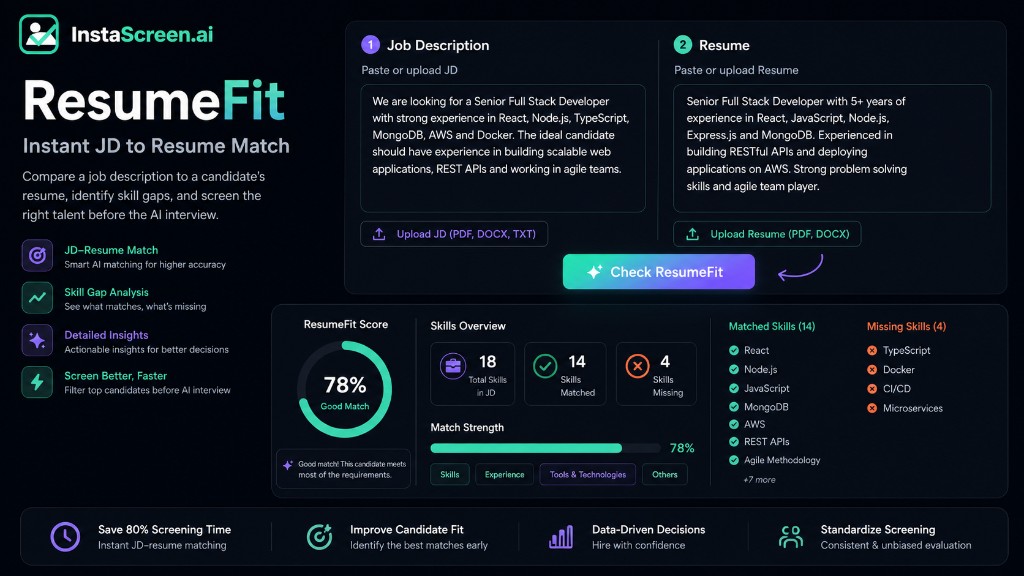
The gap ResumeFit closes
Most submission mistakes start the same way: a resume that reads aligned to the JD, but doesn't hold up when someone checks tools, depth, and real scope of ownership.
Recruiters don't need more opinions—they need a fast, structured read on what matches, what's missing, and whether the candidate is worth the next step.
What you do in two panels
ResumeFit is intentionally simple: paste or upload the JD, paste or upload the resume, then run the check.
How teams use the score
Treat the score as a routing signal, not a verdict. Strong matches move forward to your standard AI screening workflow. Borderline matches get a tighter human screen (a focused question list, a short call, or a narrower role). Weak matches get declined early—with reasons you can explain to the candidate and your desk.
Operational wins
Try it on your next role
Pick one open requirement, run five resumes through ResumeFit, and compare the score distribution to who you would have submitted on resume alone. The delta is usually eye-opening.